

It's “easy” to course-correct when you train face to face: you can see in learners' eyes whether the light is coming on or going out. In digital learning, reactions aren't visible in real time. You have to foresee them, anticipate them, make up for what's missing and rely on the motivational levers you can predict.
Building a course straight from raw content, without ever stopping to define personas (with their core needs, their motivational levers and their fears), all but guarantees it will miss the mark for a good share of participants. To prevent counterproductive habits, such as frantically clicking “Next” just to get the module marked complete in the LMS rather than to learn (yes, really, it's common, and you know it), there are two possible approaches, and they can be combined:
- Keep learners captive in the module: using “dark UX” patterns, you prevent them from moving on until they've completed every required action, such as answering a question correctly to unlock the Next button.
- Design a learning journey that is engaging, relevant and cognitively ergonomic, one that creates a “wow” effect while staying grounded in the realities of the job.
I'll admit a strong preference for the second option: making sure that each person, with their specific needs, enjoys learning all the way through.
Motivation can't be mandated
When a training programme doesn't work, you often hear: “the learners weren't motivated.” But motivation can't be mandated, and it can't be added after the fact. It emerges, holds or fades depending on how the learning journey was designed, and on the meaning the learner finds in each step.
When learners understand where they're going and what's in it for them, they engage more readily. When the journey is vague or too generic, they disengage.
Three needs, six levels of motivation
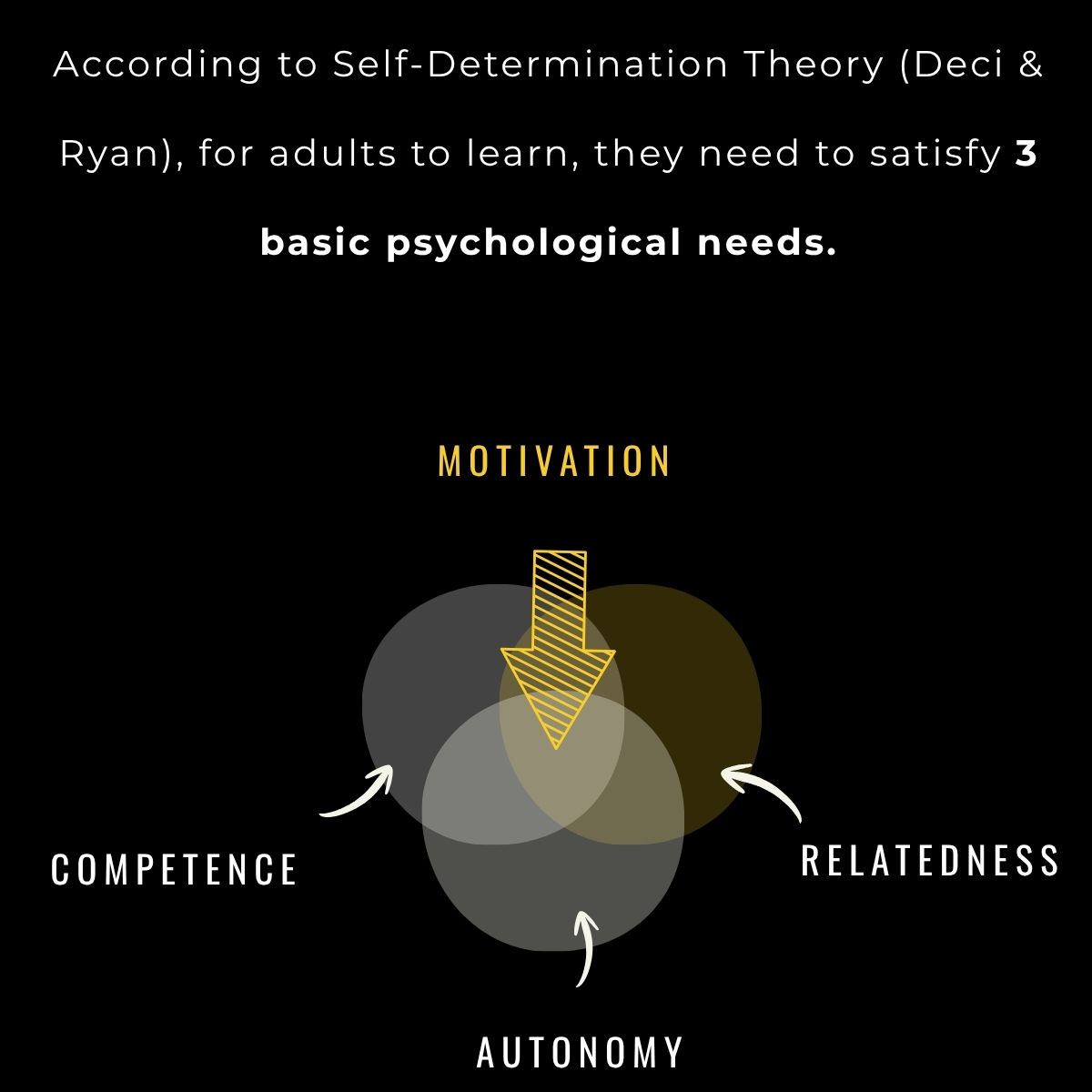
To understand where motivation comes from, I draw on Deci and Ryan's self-determination theory. According to this theory, intrinsic motivation, the most lasting kind, rests on three basic psychological needs: autonomy, competence and relatedness (a sense of social connection). Between a complete lack of motivation and the pure enjoyment of learning, it distinguishes six levels.
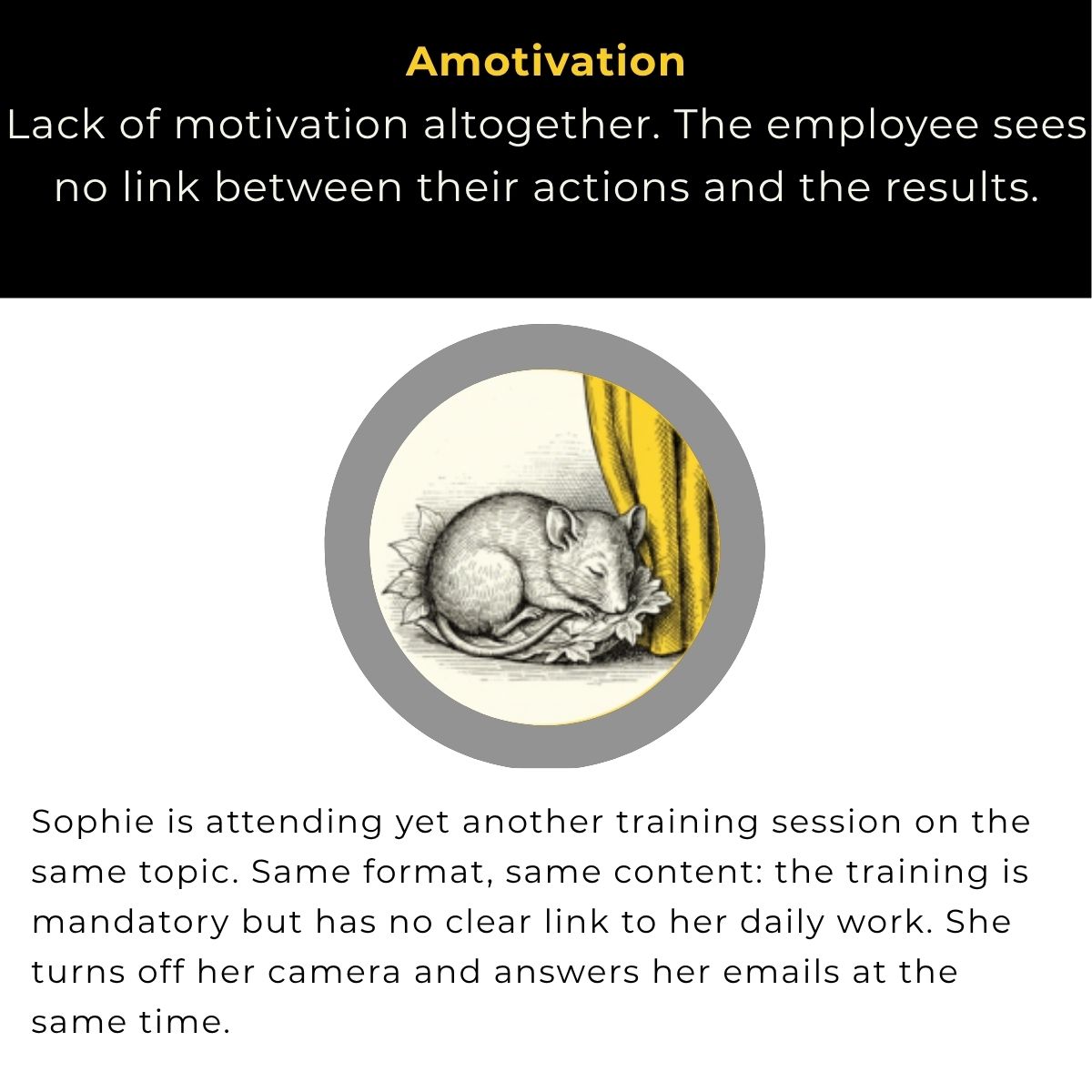
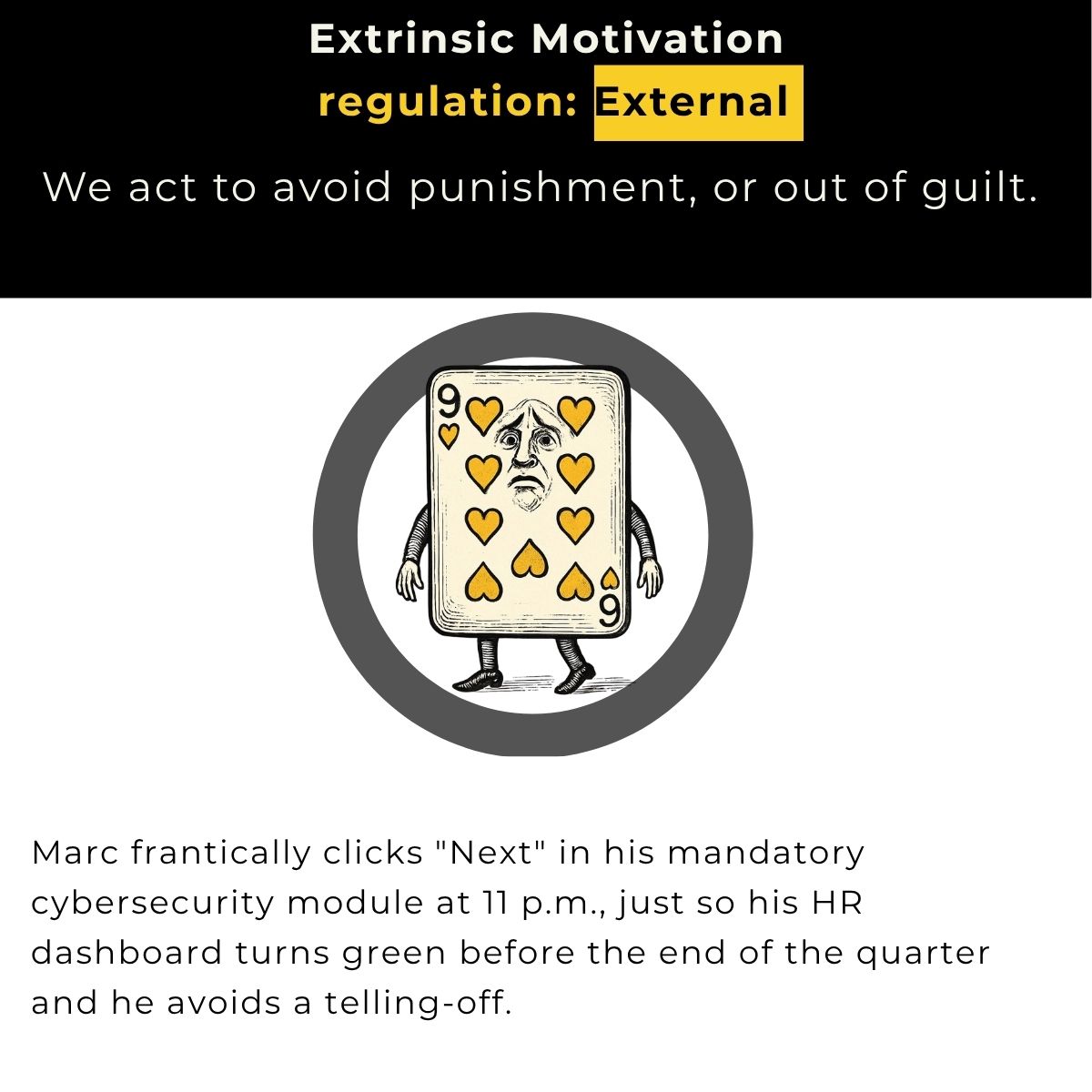
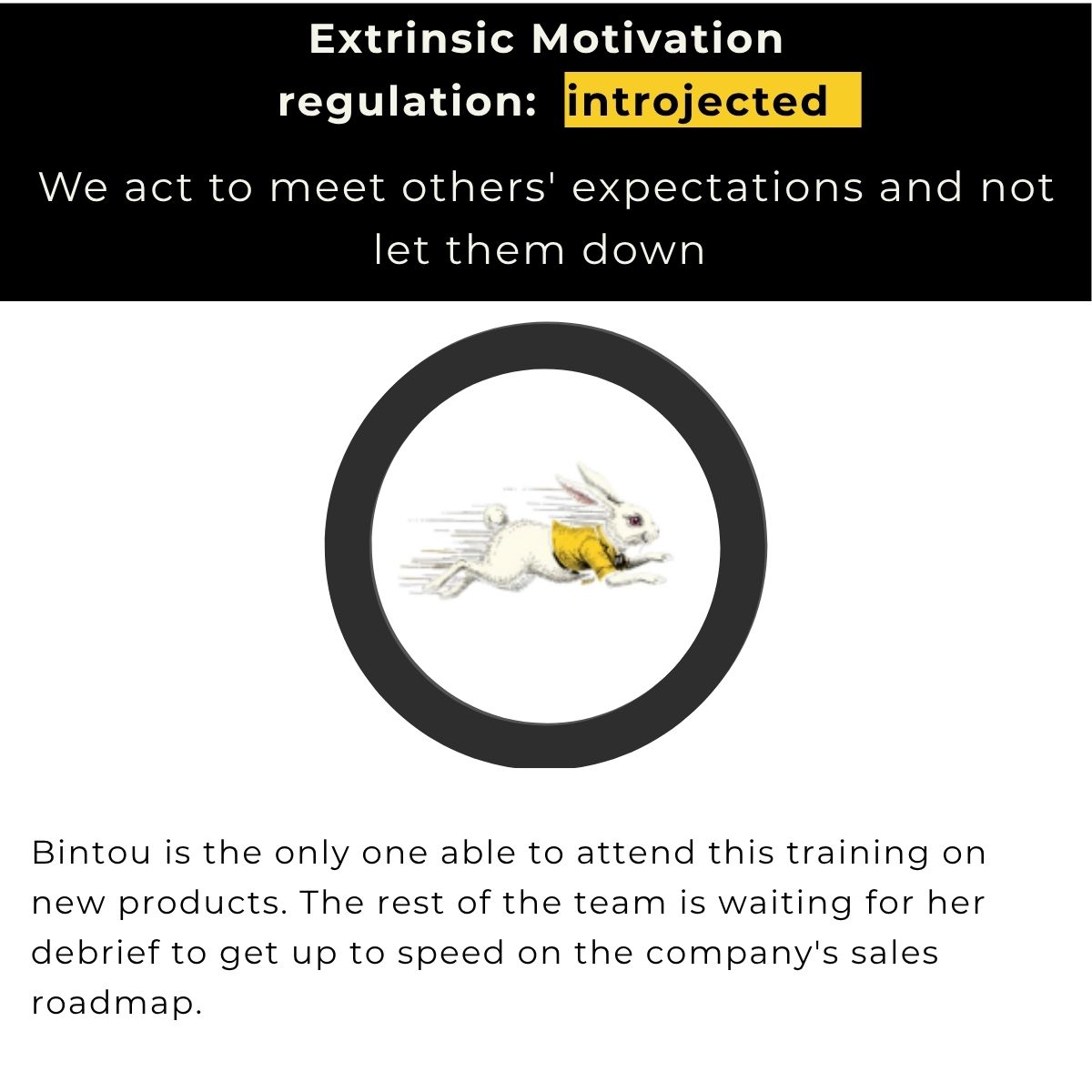
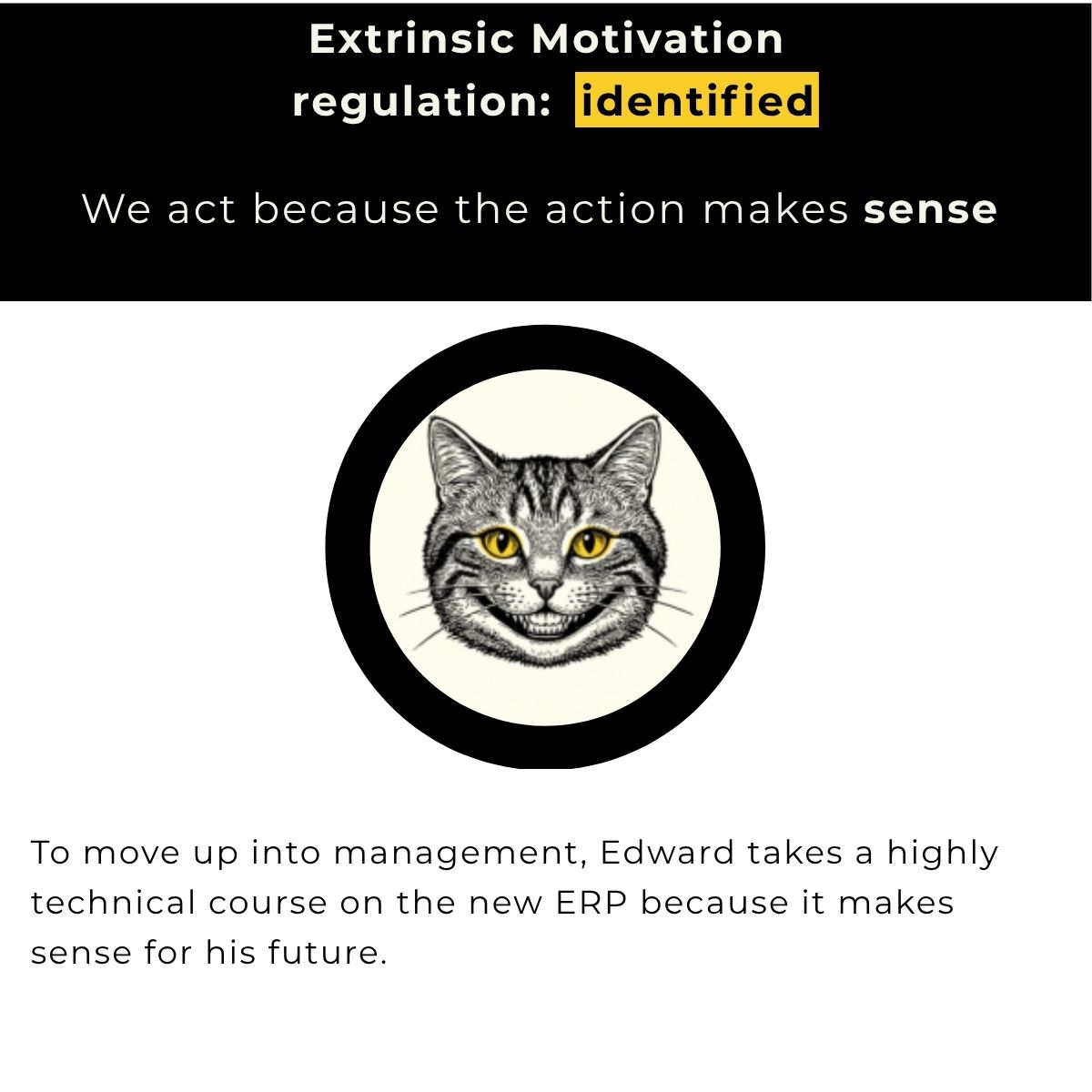
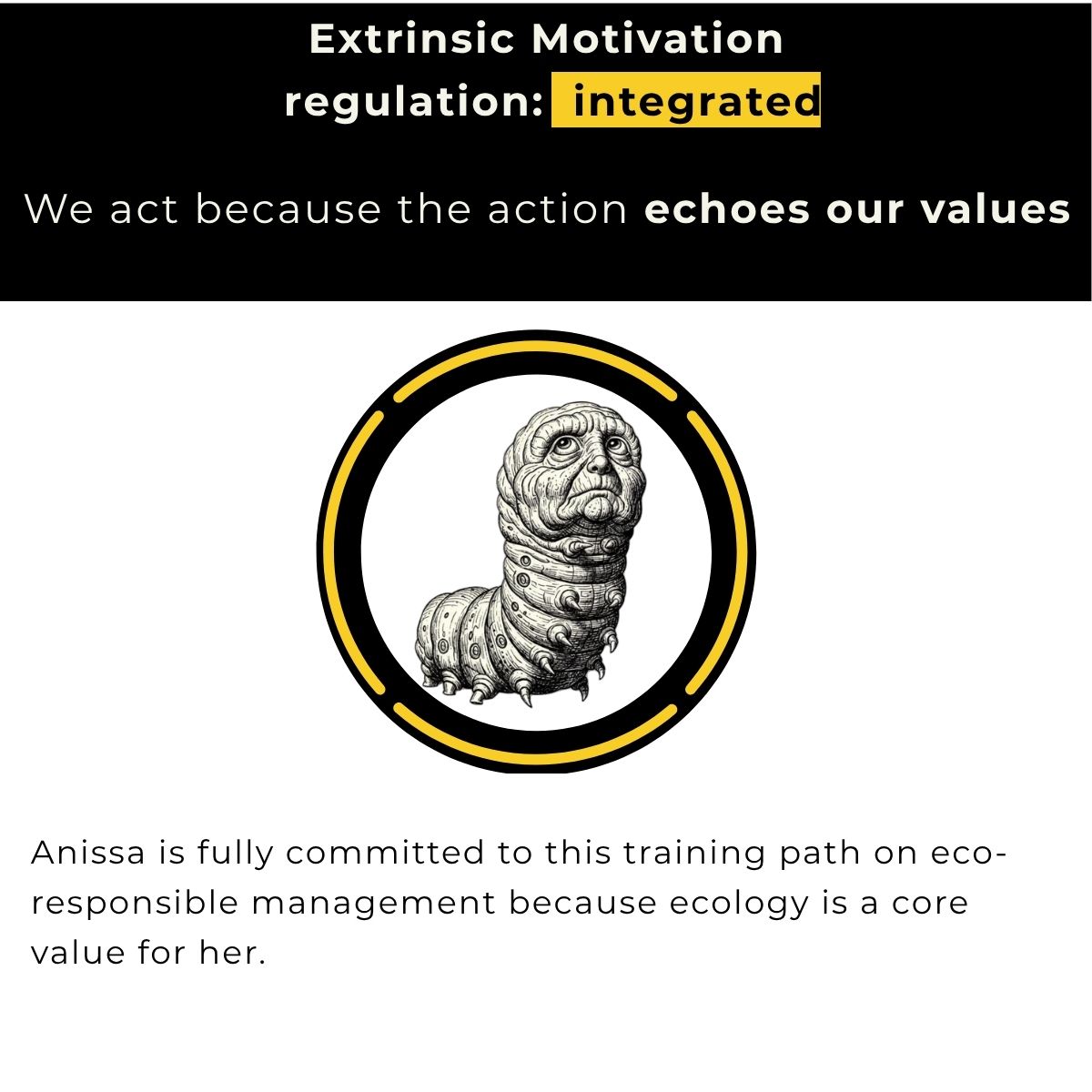
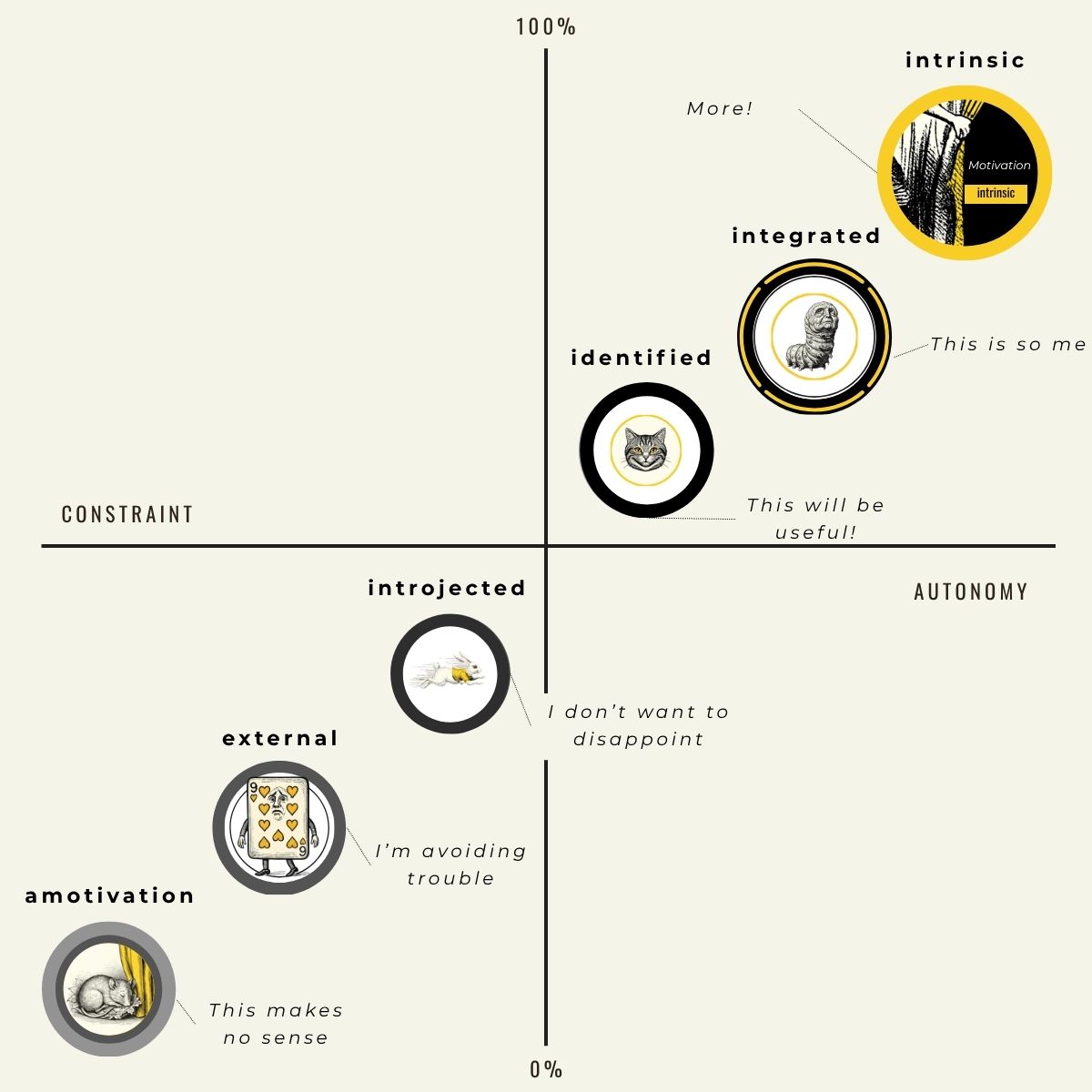
Marc, clicking “Next” at 11 pm so his dashboard turns green, is exactly the learner I mentioned earlier. The job of design is to help each person move up this diagonal, from constraint towards autonomy. And the three needs are the levers to get there.
In a multimodal learning journey, this might look like:
- For autonomy: offer choices. Learners choose or combine formats (audio, video, infographics, drawing on dual coding theory), adjust playback speed, or follow an exploratory rather than linear path. Asynchronous e-learning also lets them progress at their own pace.
- For competence: break big objectives down into clear steps, so learners can see their progress and take satisfaction from it.
- For relatedness: storytelling can help learners identify with a community of peers. Opportunities to interact do it even better: virtual classroom workshops, small-group work, asynchronous discussion spaces (Teams, Slack).
Know your audience: the question of why
To design well, you first need to know who you're designing for. And the job description doesn't tell you much.
When I interview subject-matter experts and, whenever I can, the learners themselves, I ask one question above all, again and again: why? The answers bring out their time constraints, their fears, their relationship with digital tools, and sometimes their bad memories of past training. I then keep asking that question throughout the design process, for the journey as a whole as well as for each screen. Why would they be here? Why would they click here? What would make them want to see it through?
An audience is rarely uniform: within the same group, you might meet a Sophie, a Marc and a Simon. These questions help me place each of them on the motivation scale and choose which levers to pull.
The learner's own project
Even before the first click, learners form an idea of what they're about to experience. This moment is often overlooked, yet it matters a great deal.
In adult education, Philippe Carré talks about “motives for engagement” and the projet d'apprenance, a learner's own project to learn. In psychopedagogy, Antoine de La Garanderie speaks of the “project of meaning” (projet de sens): for him, it is the first mental gesture, the one that comes before all the others (memorising, understanding…).
If learners know what they're going to do, why they're doing it and what it will change in their daily work, they engage with the training more easily. If that isn't clear, their engagement remains fragile. A little “training marketing” upfront helps spark interest: a pitch that sets out the benefits, a testimonial from a beta tester. Then the learning journey has to take over. Objectives aren't stated once at the start: they are recalled along the way, and learners are shown what they have already achieved.
Different profiles, different levers
Even within a well-defined audience, profiles vary. SONCAS, a framework from French sales training (an acronym for security, pride, novelty, comfort, money and sympathy), can be useful here if you adapt it to motivational levers.
Some learners need reassurance: clear guidance and an interface without pitfalls will put them at ease. Others look for recognition and will appreciate having their progress acknowledged. Others still enjoy novelty or a challenge, and some mainly want to get straight to the point. A training programme isn't aimed at just one of these profiles: it offers something for each of them.
Flow and the zone of proximal development
To sustain engagement over time, two concepts help me a great deal.
A state of intense concentration in which you lose track of time, because the task takes up your full attention. It occurs when the level of difficulty is well matched to the person's skills.
The space between what learners can already do on their own and what they can achieve with support, in this case from the learning design itself. Too easy, and they get bored. Too hard, and they get discouraged and give up.
The challenge is to maintain this balance from the beginning to the end of the journey.
The trap of surface-level gamification
Gamification is often expected to fix everything. Yet many programmes boil down to external rewards: points, badges, leaderboards. On a learning journey that is already well designed, these can help. The risk is replacing intrinsic motivation with purely extrinsic motivation, and leaving learners where Marc is: once the reward disappears, engagement drops.
Behaviourism still has its uses, though. A positively reinforced behaviour is more likely to be repeated, which is very useful for embedding procedures, job-specific actions or automatic responses. So I use these techniques in certain sequences, to memorise the basics, provided they are then put back to work in more complex transfer tasks. On its own, behaviourism can neither build deep understanding nor ensure that what has been learned transfers to real situations.
right up to the last screen.
Motivation is the gateway to the LXD approach. In practice, this means starting from the person who will take the training, not from the mass of content to get across, and keeping that question in mind from the first pitch to the last screen.
Several of these resources are in French: the original French title appears below the English title.
- Learner persona templatemiro.com
- WIIFM? How to involve the learner in design thinking from the get gomindtools-kineo.com
- Promoting motivation and well-being at school (ProMoBE)Promouvoir la motivation et le bien-être à l'école (in French) — promobe.univ-grenoble-alpes.fr
- Dual coding theoryThéorie du double codage (in French) — loterre.istex.fr
- Using the zone of proximal development to support learningLa zone proche de développement pour favoriser l'apprentissage (in French) — uqtr.uquebec.ca
- Flow: The Psychology of Optimal Experience — Mihaly Csikszentmihalyi, Claremont Graduate University, Harper & Row, 1990researchgate.net
- Positive psychology and adult education: flow, or the pleasure of understanding throughout lifePsychologie positive et formation des adultes : le flow ou le plaisir de comprendre tout au long de la vie (in French) — cairn.info
- The SONCASE method: 7 levers to persuade and engage your learners — Anne-Marie Cuinier, Learn & Enjoy podcast, episode 115, April 2025La méthode SONCASE : 7 leviers pour convaincre et engager vos apprenants (in French) — podcast.ausha.co